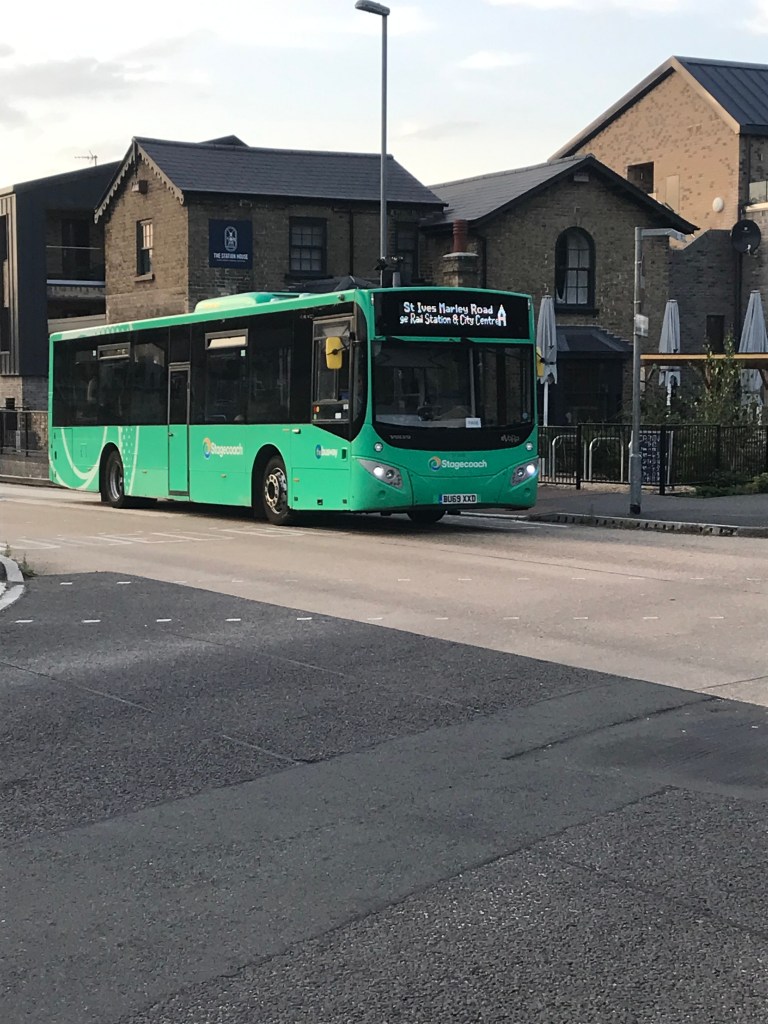
Bus franchising consultation – the bus franchising consultation is really important because it could fundamentally change how buses are run in the county. It is also really difficult to engage with writes County Councillor Ros Hathorn.
Here I try to highlight the key issues to provide a sufficient insight to be able to answer enough of the short questionnaire to have your voice heard if you won’t be reading the 126 page consultation document. The first 30 pages outline how to answer the short questionnaire and are helpfully cross referenced within the questionnaire.
Notionally the consultation is about the ‘business cases’ of an Enhanced Partnership vs Franchising but more importantly it is the consultation which will determine whether Cambridgeshire and Peterborough move to a franchised model of operating buses.
Who is running the consultation? The Cambridgeshire and Peterborough Combined Authority (CPCA). The Combined Authority works with our local councils and other organisations. It is made up of a directly elected Mayor, Mayor Nik Johnson (Labour) and seven local authorities including South Cambridgeshire District Council and Cambridgeshire County Council.
What are enhanced partnerships and franchising? Enhanced Partnership is the current model where private bus companies run services competitively for profit with the local authority pumping in some money to run unprofitable services. Franchising is where the local authority (CPCA in this case) coordinates the services. There is greater detail about these models below.
What is the business case and why does it matter? If a local authority wants to move to running franchised bus services, they must run a public consultation on the business case. The business case models today’s routes but increases their frequency, confusingly called mileage. In some ways this is counterintuitive as part of the argument for running franchised services is to support new routes, but the business case must be based in facts.
Very crudely the business case says that franchising will deliver a slightly better service for a bit more money and risk. It is split into strategic, economic, commercial, financial and management cases and a draft equality impact assessment. If you skim read the documents you can see the key graphs which outline the business case but to my mind where individuals can add important value is by being specific about their own concerns.
Why should I bother responding to the consultation, no one ever listens?This is a public consultation and there are rules around public consultations. All the responses will be compiled into a report.
It is important to comment now as although there probably will be future consultations there is no timeline for these. If you have a view on buses in Cambridgeshire submit a response to this consultation now. The Mayor can only proceed with bus franchising with the support of the board. This means if strong themes come out of the consultation for example about the type of franchising model the Mayor must consider them.
The difference between the two models, enhanced partnership and franchising in more detail
Quotes below taken from www.urbantransportgroup.org Bus franchising briefing.pdf
Enhanced Partnership is ‘a free market meaning that anyone (subject to minimum safety and operating standards) can operate bus services. Bus operators are free to run whatever services they like, the fares they will charge and the vehicles they will use. This results in an uncoordinated network with a confusing array of ticketing options. Although in theory it is a competitive market, in reality most bus services are now provided by five large companies who rarely compete against each other (Arriva, First, Go-Ahead, National Express and Stagecoach). Operators focus on the most profitable journeys, with local transport authorities having to pay operators to run journeys and some routes that are socially necessary’. This has been the situation since buses were deregulated in the 1980s.
In favour of enhanced partnership, Stagecoach argue that they already cross subsidise routes. Private companies although run for profit are often more efficient than the state. They also have clear motivation; money. So if you are arguing for a new service for your village if you can demonstrate a strong business case you stand a chance of getting it, that might not be the case in a highly political model.
Franchising ‘under bus franchising, the deregulated bus market is suspended and bus operators are only able to provide services under contract to the local transport authority. This approach is used extensively across Europe, in London and elsewhere as it offers a range of significant advantages that are impossible under partnership – such as integrated ticketing, network planning, cross subsidy across bus services and other modes and unified marketing. In short, franchising brings together the strengths of private operators in efficient service delivery but within a co-ordinated and planned public transport network. From the passenger perspective, franchising enables:
- Simple, unified and integrated ticketing and product set under one brand (which competition law prevents in a deregulated environment)
- Single identity for bus services and potentially other public transport modes, which is easy to understand for new users
- Unified, easy to use network of integrated public transport services
- Consistent standards of service, including vehicle, driver and customer care standards
- One accountable body, integrated real time information and a single point of contact for customers’
What are the disadvantages of franchising It is easy to present franchising as a perfect solution but there are some risks beyond those highlighted in the business case
- the expertise of the people running the service, the local authority is only as good as the people working there. You can get excellent people but there is a risk.
- inefficiency, whilst privately run bus companies are focussed on running tight efficient services it is harder for a local authority to be as financially tight although there is a degree of competition within the model.
- The politicisation of bus services. The Mayor is in office for 4 years. If the mayor prioritises ‘rural poverty’ all the money will go to north Cambridgeshire and Peterborough, if you prioritise ‘economic growth areas’ the money moves to the south. This politicisation can be mitigated against with an arms length organisation like Transport for London running the services.
What are the particular issues we experience as a village in the South Cambridgeshire District area? Living in South Cambridgeshire is the biggest issue we face for the delivery of good bus services through a franchised model. It is the largest most sprawling district area in the county and whereas all the other districts have large market towns, South Cambridgeshire is made up of over 100 villages. Currently there is no mechanism for the CPCA to work directly with villages and it is not gathering effective data as to what is going on at local level to inform new bus routes and increased frequency of different services.
It is my strong view that we should be highlighting the failure of the current model and how important it is for the CPCA if it moves to a franchised model to have formal mechanisms of data gathering which go far beyond the online consultations it currently relies on. Money needs to be spent on collecting data at a local, village level and there must be a mechanism for villages to talk directly to the CPCA. Local councillors do not have a clear voice within the Combined Authority and local councillors are those closest to their communities.
What are the specific local issues I’d argue that
- not having bus stops in the west of Histon.
- Orchard Park not having a direct service to Cambridge North
- An off peak 40 minute number 8 service is a very bad time interval
- Boarding and exiting buses is slow currently
- Busway buses are rammed on week and weekend mornings
- Crossing the city is really slow and frustrating. Afternoon peak congestion is terrible.
- A hopper bus connecting villages to Histon/ Impington and serving the edges of the villages connecting into the busway would be really useful.
- There needs to be a small amount of seed funding to experiment, for communities to submit ideas and compete for funding, to innovate to improve the network.
In conclusion Everyone has different bus issues. It is really important to think about what your issues are and feed them into the consultation. It is also worth considering bigger, higher level organisational issues and having a view on those as these are what are being considered. For me absolutely top of my list is if bus franchising goes ahead a separate, arms length organisation must be created like Transport for London to run buses so that they are not vulnerable to political interference.

 hiopcouncillors